Exercise for Hip OA: Pain, No Gain?
NO
PHARMACEUTICAL INFLUENCE
Exercise for Hip OA: Pain, No Gain?
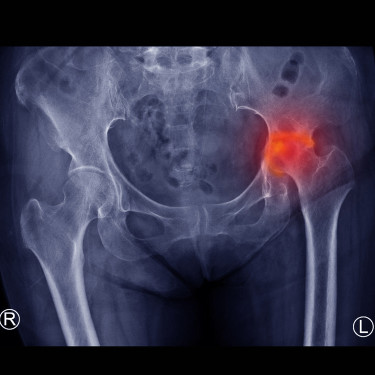
When Tom comes to see me about his hip, it is pretty clear he has osteoarthritis. It hurts when he walks, on the stairs, at night. Its stopping him doing what he wants to do, sometimes what he needs to do. Analgesia hasn’t helped.
An x-ray confirms our suspicions. He’s in his mid-50s, the kids have just left home and he was looking forward to having ‘a bit more time for ourselves’ - going travelling, just a backpack and some walking boots. Now that’s looking unlikely.
What would you advise as first line management for Tom’s hip OA?
He’s relatively young. Is it too early for him to have a hip replacement? Would exercise be a better option at this stage?
Exercise certainly seems like the logical choice, especially given his age, and is recommended in most guidance. 2022 NICE guidance on osteoarthritis (not specifically hip OA) advises therapeutic exercise tailored to the individual is a core treatment, something reiterated by the Royal National Orthopaedic Hospital. Scotland’s NHS Inform recommends muscle strengthening exercises.
I am normally a strong advocate for exercise-based treatments, particularly for musculoskeletal conditions, but a recent Cochrane review calls this approach in to question for hip osteoarthritis. Published in July 2026, this updates the previous assessment of data on exercise for hip OA from 2014.
The review included randomised controlled trials of adults with hip OA, where exercise was compared against a range of alternatives, such as placebo, usual care, limited education or a co-intervention. Thekey outcomes the team assessed were pain, physical function and quality of life.
18 studies met the inclusion criteria with a total of 1368 patients. It’s a little surprising there isn’t more data available, given this is such a huge problem – its widely reported that around 1 in 9 adults over the age of 45 have hip OA – but at least meta-analysis combines smaller studies to create something larger scale.
The results weren’t good news for exercise.
Compared to placebo or attention control, exercise appears to have little or no effect on pain or quality of life. Physical function may be improved slightly.
Compared to no treatment, usual care or limited education, exercise may improve pain and physical function marginally, but to such a small degree it was felt this would be below the minimum clinically important difference.
Bottom line: exercise doesn’t seem to work for hip OA.
Where does that leave clinicians trying to help their patients?
Hip replacement is a very effective treatment, albeit a much more invasive one. We often try to push back surgery due to concerns that the prothesis has a lifespan shorter than the patient, risking complex revision at an age where it may be increasingly difficult and dangerous.
On this front, however, there is good news for patients.
In February 2026, the Lancet published a systematic review and meta-analysis of trials on modern hip replacements including data from 8 national joint registries, comparing them to older prostheses. Almost 2 million patients’ data was included.
The results were staggering. Existing joint registry data showed 93.6% of replacements survived 20 years. Failures are likely to occur relatively soon after surgery rather than many years later. Modelling data predicted that 92.1% would survive 30 years, and it would seem feasible that many of these substitute hips could continue for much longer still.
Where does this leave Tom?
Advising exercise may still have a role in maintaining mobility and strength (and potentially improve post-operative recovery), but is unlikely to help his pain or improve his quality of life. Analgesia has been ineffective. Early referral to the musculoskeletal team would be appropriate. He may be a candidate for a steroid injection (see our NB Blog OA on the HIT trial) – more likely to help if he has active synovitis – but if he does go for a hip replacement, at least we know even at his ‘young’ age there’s a good chance it will outlive him.
Dr Neal Tucker
12th August 2026
Join us at one of our upcoming courses or live webinars



Purchase an NB Plus subscription for unlimited access to the NB Medical digital library
Recent NB Blogs
Need an immediate update? – all our courses are available on demand
Did you find this useful?
You can quickly add CPD to your account by writing a reflective note about the Exercise for Hip OA: Pain, No Gain? post you've read.
Log in to your NB Dashboard and use the 'Add Reflective Note' button at the bottom of a blog entry to add your note.