A Nail-Biting Diagnosis: Spotting Subungual Melanoma in Primary Care
NO
PHARMACEUTICAL INFLUENCE
A Nail-Biting Diagnosis: Spotting Subungual Melanoma in Primary Care
The sun is out, the BBQs are lit, and summer has finally arrived. It's therefore timely that Cancer Research UK has just reported that melanoma diagnoses in the UK have reached a record high, with more than 20,000 cases diagnosed annually for the first time which has hit the mainstream media BBC, May 2026.
Let’s meet Delroy, a 63-year-old retired carpenter attending his annual SMI review. The consultation is coming to an end when he pauses at the door.
"I nearly forgot. My daughter says I should show you this."
He holds out his right thumb.
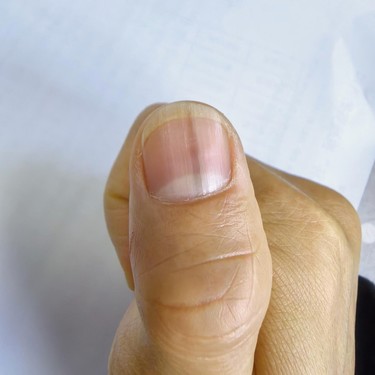
Running from the proximal nail fold to the tip of the nail is a dark brown/black linear band of pigmentation. There is no history of trauma and Delroy is uncertain how long it's been there, but his daughter thinks it's getting wider.
You pause, how confident are you assessing a pigmented nail?
The challenge is that not every pigmented nail band is a melanoma. Subungual haemorrhage, benign longitudinal melanonychia, naevi etc. can all cause nail pigmentation.
So how do we tell the difference?
One important diagnosis not to miss is subungual melanoma. Unlike many other melanomas, acral lentiginous melanoma (ALM) affects all skin types and is the most common melanoma subtype seen in people with skin of colour. ALM occurs on the palms, soles and includes subungual melanomas. Perhaps the most famous example was Bob Marley, who tragically died aged 36 from a subungual melanoma.
Subungual melanoma usually affects a single nail, presenting as a pigmented band that originates in the nail matrix and extends from the proximal nail fold to the tip of the nail. A recent paper by Professor Aimilios Lallas and colleagues proposes a memorable way to assess these lesions which I’ve adapted as the acronym HANK CSI. This comes from Hank, a paramedic character from the television series CSI.
H – Haemorrhage. Subungual haemorrhage is far more common than subungual melanoma therefore requires exclusion. Rather than a straight pigmented band, it typically appears red-purple with well demarcated curved projections, peripheral blood spots and pigmentation that gradually grows out with the nail plate [Click here for images].
A – Age matters. The risk of melanoma increases with age and is exceptionally uncommon before the age of 30.
N – Number of nails. Melanoma almost always affects a single nail, particularly the thumb or big toe [Click here for images].
K – Keratin thickening. Localised thickening at the distal nail edge makes melanoma less likely and should prompt consideration of alterative diagnoses such as SCC.
C – Colour. Grey pigmentation is more likely to be benign. Brown or black pigmentation is more concerning.
S – Size. As a subungual melanoma enlarges, the pigmented band becomes wider proximally than distally, creating a classic triangle sign. The nail effectively provides its own timeline, showing that the lesion has been growing over time.
I – Irregularity. Multiple shades of pigment, irregular parallel lines, nail dystrophy or extension of pigment onto the surrounding nail fold (Hutchinson's sign) are all red flags.
As for Delroy? He was referred on an urgent suspected cancer pathway to dermatology.
If you'd like more practical tips on recognising and managing common skin conditions in primary care, join us live on Saturday 20th June for our newly updated Dermatology for Primary Care webinar. We'll cover the core dermatology topics of skin cancer, eczema and psoriasis, alongside new topics on alopecia, pregnancy-related dermatoses, hidradenitis suppurativa and bullous disorders.
Dr Philippa Davies
16th June 2026
Join us at one of our upcoming courses or live webinars



Purchase an NB Plus subscription for unlimited access to the NB Medical digital library
Recent NB Blogs
Need an immediate update? – all our courses are available on demand
Did you find this useful?
You can quickly add CPD to your account by writing a reflective note about the A Nail-Biting Diagnosis: Spotting Subungual Melanoma in Primary Care post you've read.
Log in to your NB Dashboard and use the 'Add Reflective Note' button at the bottom of a blog entry to add your note.